
If you ask ten different SEO experts to define white hat link building, you will get a confident answer, and it will not quite match the other nine. One will tell you that any outreach email is manipulation. Another will insist that paid guest posts are okay if the site is "good". And a third one will dismiss the entire notion of the white-grey-black hat distinction altogether because Google simply does not care anymore.
But that lack of clarity was deliberate, and lucrative. The distinctions between various types of link building have always been blurred intentionally by the industry that has a financial interest in maintaining them this way. Aggressive marketing vendors rename the practices in order to make them sound safer: the same link network becomes a "publisher ecosystem" and the same link placement becomes "editorial outreach".
In this guide, we are going to try to clarify the line as honestly as we can. Not how marketing departments draw it, but where Google draws it, where enforcement systems draw it, and where the real-world outcomes of the last ten years of SEO draw it.
First, What Do the Hats Actually Mean?
The hats terminology came from classic Western movies where heroes wear white hats and bad guys wear black ones. As applied to SEO, it translates into the following:
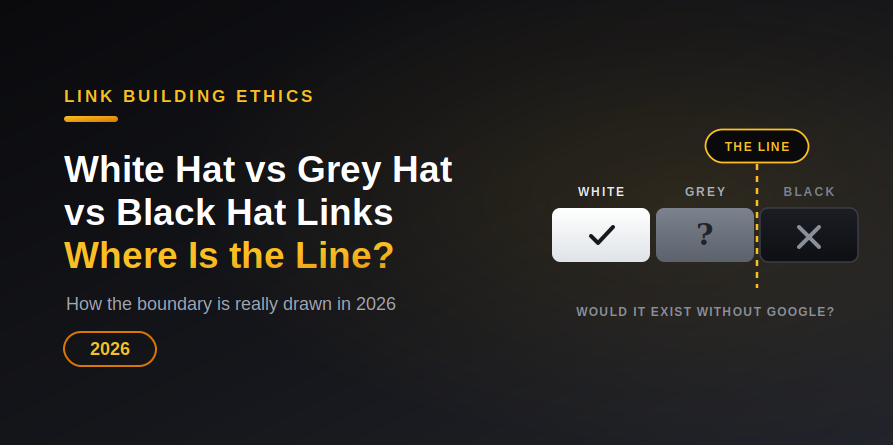
- White hat: tactics that comply with search engine guidelines and would make sense even if the search engines did not exist. The link is created due to the genuine choice of the editor.
- Black hat: tactics that go against the spam policies of search engines and require deception of the algorithm in order to work. The link does not exist for any reason except for manipulating rankings.
- Grey hat: everything else. Tactics that are not explicitly prohibited, or are prohibited, but widely used, normalized, and inconsistently enforced.
Most of the link building industry works in the middle, which is why the bulk of this article is about that too. However, let's define the opposite poles first, because understanding the middle requires knowledge of the two.
White Hat Link Building: The Unambiguous Zone
A link is white hat if a free decision of the editor led to it. No payments took place, and no manipulation happened.
Tactics that clearly fit
- Digital PR and data campaigns. You produce original research, surveys, or analysis, and you pitch it to journalists who cover it because it is interesting for their audience. The journalist could have rejected the idea, but she chose to cover it.
- Expert commentary. You reply to journalists through Connectively, Qwoted, or Featured and your quote is used because you brought value to their story.
- Linkable asset creation. You build calculators, free tools, unique datasets, or definitive guides that people would naturally reference.
- Unlinked mention reclamation. Someone mentioned you, and you just kindly remind them to turn the mention into a link. The process did not affect the editorial decision.
- Genuine guest posts. You write for publications because you have expertise to share, the publication has an audience, and no exchange of payments took place for the link.
- Broken link building and resource suggestions. You found a broken link for the site owner and recommended the resource that will replace the original.
The criteria of white hat
There is one and only: would this link still exist if Google went offline tomorrow?
A journalist citing your study would still cite it. A blogger recommending your tool would still recommend it. But a link bought on the marketplace or published on some non-existent website does not exist for anyone except for an algorithm. If the only beneficiary of a link is the algorithm, that link is not white hat, no matter what the invoice says.
The awkward truth about outreach
SEO purists claim that any proactive outreach taints the link, as the links should appear naturally without asking. This is an unrealistically strict requirement. Journalists receive pitches all the time. Editors receive contributions. The whole media business model depends on people suggesting content to publishers who then decide whether to accept it or not.
The criterion is not whether you asked. The criterion is whether the editorial decision was free. Asking is fine. Paying for getting a yes, or fabricating the publisher, is not.
Black Hat Link Building: The Clear Violations
At the opposite pole sit the practices that exist exclusively to deceive ranking systems, violate Google's spam policies completely, and, in some cases, hurt third parties. We describe them to help you recognize and avoid them in your vendors' approaches and in your own backlink portfolio, not to use them yourself.
Categories of black hat SEO
- Private blog networks (PBNs). A network of websites, often built on expired domains with retained authority, that serve exclusively as a source of outbound links to money websites. The content on them is random, the "authors" are fictional, and their existence is just link laundering.
- Automated link spam. Software that spams links in comment sections, forums, wikis, and profiles in order to boost rankings. This is the oldest trick in the book, and probably the most extensively defeated one too.
- Hacked link injection. Compromising legitimate websites and injecting hidden links into their pages. This is not only black hat SEO; this is a crime, and any vendor that puts their links on hacked sites should not just be fired, but reported.
- Mass-scale undisclosed paid links. Buying mass-scale paid links that pass ranking signals without any disclosure or rel="sponsored" attribute. Pay attention: this is an explicit description of the tactic that the majority of the industry considers normal. We are coming back to this issue in the grey hat section.
- Link exchanges at mass scale. Systematic "you link to me and I link to you" practices, including three- and four-way link exchanges in order to mask the fact that they exist. Two or three mutually agreed-upon links from the sites you work with is not a link exchange; a list of swap partners is.
- Deceptive redirects and cloaking. Providing search engines with a different structure of links than the users see, or purchasing expired domains and redirecting their entire link equity to a site in a completely unrelated niche.
Reasons why black hat fails harder in 2026 than ever
For a long time, the truth about black hat SEO was awkward: it worked, and some SEO practitioners became rich until it didn't work anymore. In 2026 the equation has genuinely changed.
- Devaluation became the default instead of a penalty. Google's SpamBrain algorithm now neutralizes manipulative links silently, without any penalty to the site. This might sound nicer, but in effect it is much worse for the buyer: you keep paying for links that are dead for ranking purposes without even knowing it.
- Pattern recognition became machine-scale. PBNs, link exchanges, and paid-link footprints are exactly the kind of patterns modern classifiers excel at recognizing. Once a network is detected, the equity of every site linked from it dies at the same time.
- AI search added another judge. Even if your black hat practice evades Google's spam filters, it will earn you nothing in AI answers. ChatGPT, Perplexity, and AI Overviews cite sources that have reputation-based signals. Nobody ever cited a PBN in an AI answer engine, and nobody ever will.
- The economics of the deal has inverted. For a long time, black hat won on the cost of links. But the flooding of the spam ecosystem with AI-generated content forced Google to improve its measures, reducing the lifespan of every black hat link.
Grey Hat Link Building: Where the Industry Actually Lives
And now for the real deal. If white hat and black hat were all that there was to discuss in SEO, this would be a short guide. But the reality is that a lot of commercial link building happens in a zone where the official policy is one thing, the industry practice is another, and enforcement lands somewhere in between.
The definition of the main grey hat tactic: paid placements marketed as editorial
Google's policy on this is clear: if links are bought or sold in order to affect search rankings, they must carry a rel="sponsored" or rel="nofollow" attribute. However, there is a huge market for links on real websites with some payment made somewhere along the chain of the transaction: a "publishing fee", an "editorial fee", a "content partnership".
Why do we define this practice as grey hat rather than black? There are three reasons:
- The practice is universal enough that enforcement is selective. Google devalues the links it recognizes, but it does not recognize everything, and sites with good signals survive even in the presence of some paid links.
- The quality varies dramatically. A paid placement on a reputable site with real readership and editorial standards works quite differently from placing the link on a link-selling site.
- The relationships are genuinely mixed. Sponsorships, event partnerships, and affiliate relationships create situations where money and links go hand in hand for valid business reasons, and the intent behind it is impossible to recognize from the outside.
Other tactics that belong to grey hat link building
- Niche edits or link insertions. Inserting your link into an existing article on a real site. If the site owner agrees to add your resource to her article because it enhances it, this leans white hat. If money is changing hands and the sites regularly insert links for money, it is dark grey, because link-inserting sites create one of the most detectable footprints in SEO.
- Guest posting at scale. A thoughtful guest article on a respectable site is white hat. Fifty templated articles per month on the "write for us" sites whose only business is publishing them becomes grey, and then black. Google warns about large-scale guest posting campaigns using keyword-stuffed anchors.
- Expired domain rebuilding. Rebuilding a lapsed domain into a real website is legitimate practice. Buying it and harvesting the old backlinks for an unrelated site is manipulation. The tactic is the same; intent and execution are different.
- Aggressive anchor optimization. Nothing forbids you from asking for a specific anchor. But designing a portfolio where the majority of links have exact-match commercial anchors is a manipulation signal by itself, no matter how each of the links was obtained.
- Reciprocal and community linking. Links between partners, suppliers, and industry contacts are a natural phenomenon. Schemes organized into rings in order to look like communities are black hat.
Criteria to make grey hat decisions
Each grey tactic requires a careful weighing of four factors:
- Footprint. Does the tactic leave an easy-to-detect pattern? Paid links on habitual link sellers do. One sponsored partnership with a real industry publication barely does.
- Blast radius. What would be lost if this practice becomes devalued? One link, or the entire portfolio built on it?
- Disclosure options. Could you obtain the major part of the value by using a rel="sponsored" link? Sponsored links still generate referral traffic, brand visibility, and citations in AI answers. If the answer is "the client only accepts followed links", ask them why.
- Portfolio share. A portfolio with 90 percent legitimate links can afford ambiguity in the other 10 percent. A portfolio with 90 percent grey can expect an update at the worst possible moment.
Where Exactly Is the Line in 2026?
If there is a single principle to remember, it is this: the line is not drawn around tactics anymore. It is drawn around footprints and intent.
Google does not maintain a simple blacklist of manipulations anymore. Instead, it detects footprints: sites that sell links, link exchanges, unnatural growth and shape of portfolios, clustering of commercial anchors. The same nominal tactic, a guest post, a link insertion, a sponsorship, can be positioned anywhere on the spectrum depending on the site hosting it, the scale at which it is executed, and the honesty of the presentation.
That is why you have a three-question test for any link and any vendor:
- Did a real editor freely choose this link? If yes, you are in white hat territory.
- If not, is the commercial relationship disclosed, and would the placement be defensible if Google looked at it? If yes, you are in grey hat territory.
- Would the tactic work if everyone looked closely at it? If no, you are in black hat territory, whatever the vendor claims.
The wording trick to watch for
The industry tries to launder risks with words, and the 2026 vocabulary is quite advanced. Here are the translations:
- "Curated placements on our publisher network" usually means PBN or reseller links.
- "Guaranteed DR 50+ links" means paid links, because earned links cannot be guaranteed.
- "Editorial fee" or "publishing fee" means paid links.
- "White hat outreach" from an agency that provides you with fixed monthly amounts of links at a low price means grey hat at best.
No legitimate tactic needs any word substitution. When a vendor uses vague language to describe their services, that vagueness speaks for itself.
What This Means for Your Approach and Vendor Choice
If you are doing link building yourself
Create the foundation of your portfolio from unambiguous white hat practices: digital PR, expert commentary, linkable assets, and reclamation. If you want to play in the grey territory marginally, do it with your eyes wide open: prefer real sites with real readers, keep grey hat practices in a minority of your portfolio, avoid footprints of any kind, and never allow a single scheme to carry a meaningful amount of equity.
If you hire an agency
The hats provide a straightforward way to vet vendors of any service:
- Ask them to classify their tactics in white-grey-black terms. Confident, clear answers show competence. Claims of being "100 percent white hat" combined with guaranteed monthly volumes of links show dishonesty or ignorance, because pure earned links do not happen on a regular schedule.
- Ask how they handle disclosure in case money changes hands anywhere in the process of placing the link.
- Ask them the manual review question: "What percentage of the links you build would you be able to defend in front of a Google search quality analyst, face to face?" The pause before the answer says much more than the answer itself.
The underlying question
Strip away the terminology and you'll see that it is a question of choosing between two models of SEO. One model says that rankings are a system to be gamed, and the game is worth playing until the rules change. The other model says that rankings are the by-product of being referenced, and the task is to create something worthy of citation.
The first model has lost ground with each year since 2012. With silent devaluation, machine-scale pattern detection, and AI engines that only cite legitimate authority, it is losing faster than ever. The second model takes more time and money to execute per link, but it builds the equity that compounds.
The Bottom Line
White, grey, and black hats were never really about hats. They were always about one question: does this link exist because of the genuine value of the content, or because of payments or manipulation?
In 2026 this question acquires teeth it never had. Search engines answer it statistically, at scale, and silently. AI answer engines answer it by not citing manufactured authority. And your competition answers it every time they create something reference-worthy while someone else fills a cart on a link marketplace.
Where is the line then? The line has always been there, it is just that on the other side of it there is now a better enforcement mechanism: between the links that would still exist without Google, and the links that would not. Build the first, be honest and careful about the second, and reject any vendor who cannot name what they sell clearly and confidently.

About the author
Fabi Gylgonyl
Link building specialist · Intseo Media
Fabi Gylgonyl is a link building specialist who helps international and multilingual brands earn authoritative, editorial backlinks across dozens of languages and markets. He focuses on manual, white-hat outreach and digital PR that holds up through algorithm updates.