
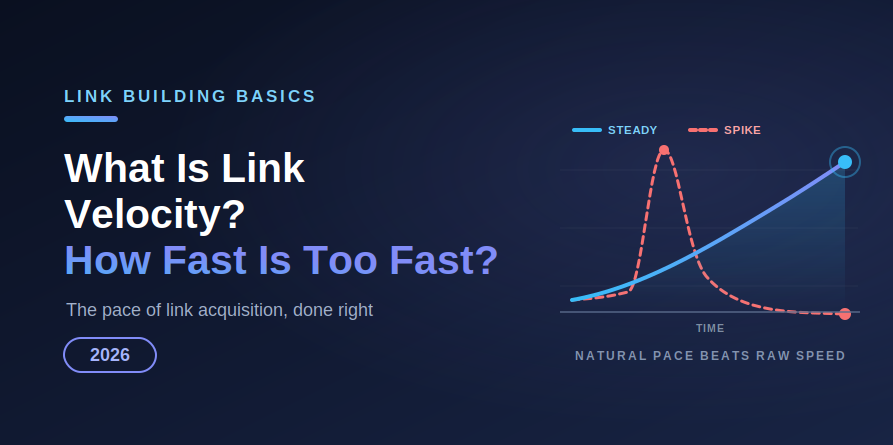
Two companies start building links on the same day. The first company gets a slow but steady stream of high-quality backlinks over several months, while the second company buys a thousand links within one week because it wants to see immediate results. After half a year, the first company climbs up the rankings and enjoys a stable organic traffic increase, while the ranking position of the second company stops moving, or even drops to zero. The main reason for such a difference in performance lies in the understanding of one important but little-known concept: link velocity.
Link velocity is one of these silent factors that determine the fate of your link building campaign. When managed properly, link velocity ensures natural and sustainable growth of authority. However, if you overlook it, you might raise the alarm bells and undo all your efforts. Yet many businesses don't know anything about link velocity, or know nothing about how to deal with it.
In this article, we will discuss the concept of link velocity and its key aspects in detail. We will learn how fast is too fast, and how to manage link velocity successfully. Let's begin with the basics.
What Is Link Velocity?
Link velocity is the speed of obtaining links during a certain period of time. If this month you got ten new backlinks and the next month fifteen backlinks, then this pace is your link velocity.
It's important to understand that it's not about quantity, but about the speed of acquiring links. Two sites may have a thousand backlinks each, but the pace of getting these links differs. For example, one site acquired its links steadily over three years, while the second website acquired them during one month. Such differences in the velocity of link acquisition create a very different impression for search engines.
Why Search Engines Consider Link Velocity Important
Search engines are constantly trying to filter out artificial manipulations and reward those websites which have obtained links naturally and organically. The pattern of link acquisition is one of the signals that search engines take into consideration.
How does it work? When you have naturally obtained links to your website, you get the following pattern:
- Publication of valuable content leads to acquiring a flurry of links and then slows down;
- Growth of a brand leads to acquiring more links with time;
- A viral post attracts more links.
However, it is rather suspicious when you obtain a lot of links without any reason for it: there was no viral post, no brand launch, or news event.
So, the search engines consider your link velocity a signal of natural link acquisition or, conversely, artificial obtaining of links.
Why Link Velocity Is Important
There are several reasons why link velocity is important and deserves your attention.
It Serves as a Signal of Naturalness (Or Lack of It)
One of the most important reasons to consider link velocity is the signal of authenticity. Link velocity that looks natural proves that your links are really earned and valuable. In the case of unnatural link velocity, it shows that the authority of your website is built artificially.
It Affects the Sustainability of Your Link Building Results
The result of your link building depends largely on link velocity. In the case of slow, steady velocity and high-quality links, you will have sustainable results. But if your link velocity is fast, your results will be very fragile and temporary.
It Impacts the Risk
If you have a good link velocity, your rankings will remain at a high level. Conversely, unnatural or aggressive link velocity leads to an increased risk of algorithmic check. So, management of your link velocity is an essential part of risk management.
How Fast Is Too Fast?
This question sounds very reasonable, and there is no definite answer. Anyone who tells you that you should acquire links according to a certain number is oversimplifying the issue. Still, there are principles which will help you to assess the danger of your link velocity.
The Point Is Not in the Speed, but in Naturalness
One of the basic principles you should remember is the fact that search engines do not punish the link velocity. They react to patterns that look manipulative. A fast link velocity is okay if there is a context for this pace.
Compare the following examples:
- Healthy link velocity: A startup launches a company, gets covered in the press, goes viral on social networks, and earns hundreds of links within a month. It's a fast velocity of links, but it is explainable and natural.
- Suspicious link velocity: An unknown website with zero traffic, no press coverage, and without any notable content suddenly earns hundreds of links from unreliable, spammy, and low-quality sources. This is a fast velocity, which cannot be explained in any way.
These two scenarios have similar link velocities, but very different contexts.
Red Flags That Can Show Your Velocity as Suspect
Instead of counting links per month, you should watch for these red flags that might show search engines that your link velocity is suspicious:
- Unexplained link spikes: You have got a lot of links without any content or PR campaign.
- Low-quality sources in bulk: Very fast acquisition of links from spammy and irrelevant sources.
- Over-optimized anchor text: A lot of new links with the same anchor text, which is used for exact-match commercial keywords.
- Lack of additional brand signals: A flood of links which was not accompanied by an increase in brand searches, direct traffic, and mentions.
- Unusual link-to-content ratio: You have got too many links for your content.
When there are several of these red flags, your link velocity starts to look suspicious.
What Healthy Link Velocity Looks Like
Healthy link velocity usually has the following features:
- Consistency: You should have a steady pace of obtaining links.
- Growth: It should grow gradually according to the natural growth of your brand.
- Activity correlation: You have got link spikes after publishing posts, campaigns, or content.
- Quality: You get your links from reputable and topically relevant sources.
- Diversity: You have got links with a different nature, source, and anchor texts.
Possible Consequences of Unmanaged Link Velocity
In order to understand the importance of managing link velocity in a proper way, it is useful to consider the dangers of mismanagement of your link velocity.
The Risks of Building Links Too Fast
When you push your link velocity too fast and it has no natural explanation, you may face the following consequences:
- Algorithmic devaluation: Search engines might devalue your links, and you will spend money on links that do not bring you any benefits.
- Increased algorithmic scrutiny: Artificial link velocity causes close monitoring of your website and your link profile.
- Loss of money: When you acquire low-quality and useless links, you spend your budget fruitlessly.
- Unstable results: Any result that you have got using artificial link velocity is going to be unstable and temporary.
The Neglected Danger of Link Building Too Slowly
Don't forget about the opposite problem of too-slow link building. Despite the fact that it's less risky, an overly slow pace of link building can cause the following disadvantages:
- Loss of time;
- Stagnant results.
How to Manage Link Velocity Correctly
If you want to manage link velocity in a proper way, you should think about consistency, quality, and activity of your link building, not only about speed. How should you build links in order to avoid unnecessary risks?
Prioritize Consistency
Consistency should be your priority in the case of link velocity. Continuous link building usually brings better results than bursts and sporadic efforts. Consistency shows the search engines that your links are growing sustainably and naturally. It also allows you to accumulate authority and boost it further.
Let Content and Campaigns Cause the Spikes
If your link velocity grows suddenly, it should be because of some activity:
- Publishing of research;
- Starting a PR campaign;
- Creation of a free tool or resource;
- Press coverage.
In this case, it looks like you got more links because of some activities and natural processes.
Focus on Quality and Relevance
Link velocity should never be put above the quality of links. A smaller number of high-quality links is always better than a large number of poor links, whatever the link velocity. High-quality links lead to natural link velocity automatically.
Create a Diverse and Natural Link Profile
A diverse link profile is a sign of natural link velocity. Different types of links, diverse sources, and different anchor texts are going to create a natural impression.
Monitor Your Link Profile
You should monitor your link velocity to see whether you have got unexpected spikes (which might mean that someone has conducted a negative SEO attack against you) or whether there is some stagnation.
Misconceptions About Link Velocity
There are a lot of misconceptions in this field. Let's try to clarify them.
Misconception #1: There Is a Universal "Safe" Number of Links Per Month
As we mentioned previously, there is no universal limit. Each link velocity is relative to the site's size, age, authority, and situation. Anyone who claims that there is a fixed number of links is simplifying the concept.
Misconception #2: The Fastest Is the Best
Speed for the sake of speed doesn't work well. When you push your links too fast, you take unnecessary risks and spend your budget unproductively.
Misconception #3: The Slowest Is the Safest
Though consistency is very important, being unnecessarily slow might cost you time and results. The right velocity is the one which is appropriate for your site and competitive landscape.
Misconception #4: Link Velocity Is the Most Important
Link velocity is important, but it is not the only factor. Quality, relevance, diversity, and the strength of your content matter as well. A successful link building campaign combines all of these elements.
Why a Professional Link Building Agency Can Manage Link Velocity Perfectly
A professional link building agency manages link velocity with the help of these methods:
- Evaluating your current position: Assessment of your site's age, authority, and existing link profile to determine the adequate pace.
- Planning of campaigns: Creating the plan of sustainable link building.
- Connecting links with strategies: Coordination of link building with your campaigns and content in order to have a reason for every link spike.
- Quality and diversity maintenance: Making sure that the link velocity is not fast enough to reduce the quality and diversity of links.
- Continuous monitoring: Observing your link profile to find mistakes in time and adjust link velocity if necessary.
- Adjustment to the competitive landscape: Calibration of link velocity depending on your competitors.
The advantage of this approach is obvious. Instead of guessing the optimal link velocity, you can trust specialists who have the necessary experience for this.
Conclusion
We hope that this article gives you enough information about the concept of link velocity. Let's summarize our main ideas.
- Link velocity is the speed of obtaining links, which serves as a signal of the naturalness of your links.
- There is no universal safe limit of links. Link velocity should be estimated depending on the current state of your site.
- Speed is not the most important thing. The naturalness of link velocity is the most important thing.
- Be aware of these red flags: unexplained spikes, low-quality bulk links, and over-optimized anchors.
- Both fast and slow velocities have their disadvantages, and it's up to you to find the balance between them.
- Consistency, quality, and connection with activity are the keys to good link velocity.
- A professional link building agency knows how to calculate optimal link velocity.
Final Words
Link velocity is one of those behind-the-scenes factors which separates successful campaigns from unsuccessful ones. It is not the thing to be afraid of, and it definitely is not the reason not to build links. It's just a reminder that how you are building your links is as important as how many links you are building.
The winners of the competition understand this fact intuitively. They build links consistently, naturally, and in correlation with real value. This way of building allows them to grow their authority naturally. And when they need help in finding the balance, they turn to specialists who do this every day.
Are you ready to build backlinks at an optimal pace, fast enough to compete, natural enough to stand the test of time? This is exactly what strategic link building gives you. Let's discuss the current state of your site and build a campaign for its successful development.

About the author
Fabi Gylgonyl
Link building specialist · Intseo Media
Fabi Gylgonyl is a link building specialist who helps international and multilingual brands earn authoritative, editorial backlinks across dozens of languages and markets. He focuses on manual, white-hat outreach and digital PR that holds up through algorithm updates.