
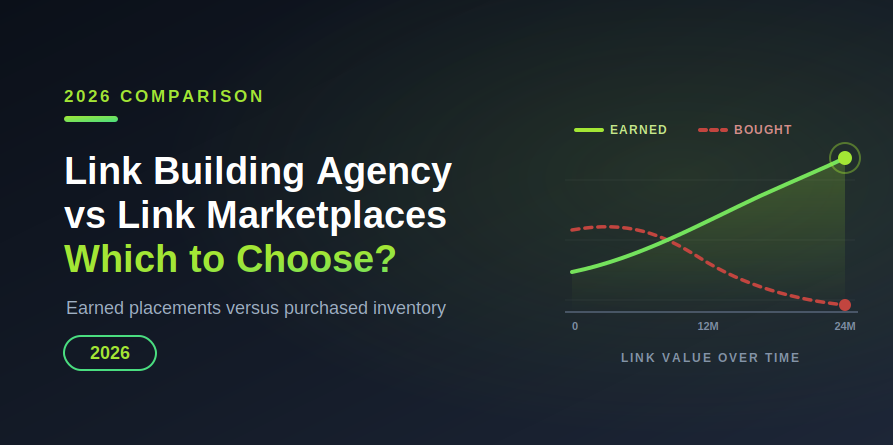
All business entities engaged in serious SEO efforts eventually come to this decision point. Namely, they are aware of the importance of having backlinks, of the expenses that go into building one's own network, and then realize that there are two completely distinct strategies for acquiring these links: either hire a link-building agency or sign up on a link marketplace to buy links yourself.
It looks pretty straightforward, doesn't it? Marketplaces are cheaper and faster. Agencies are more expensive and slower. Simple as that, right?
Not quite. There are more distinctions between these two models and, in 2026, they matter more than ever. This article is going to help you navigate through these differences and find out which of the approaches is suitable for your case.
Defining the Models: What is What?
Let us start with the definitions so we don't have to discuss the marketing terminology used by both sides.
What is a link building agency?
A link building agency is a specialized company providing services for link building campaign implementation on your behalf. To be more precise, a proper agency provides:
- Strategic planning: analysis of your website, your competitors' efforts, and the niche in general to determine pages requiring links;
- Prospecting: identification of websites relevant enough to link to;
- Content and assets: creation of guest blog posts, data studies, expert commentary pieces, and PR campaigns that may result in a link;
- Outreach: reaching out to publishers to negotiate the placements of your content/anchors and making sure these links are earned;
- Quality control and reporting: evaluation of each and every website, monitoring of the links, and tying them to the rankings and traffic growth.
You pay for a process and for the expertise of the agency. The links are the output of this process.
What is a link marketplace?
A link marketplace is a platform that connects buyers needing link placements and sites willing to offer their pages to link from. All you have to do is log in, filter the available sites based on metrics such as DR, DA, traffic level, niche, and the price, add sites to your cart, submit the anchor text/content, and the marketplace will publish the link and handle the payment.
There are many such platforms in the market now, operating similarly to an e-commerce store offering links for sale. Tons of sites to choose from, transparent prices, instant ordering. You pay for the inventory, and you are your own strategist, vetter, and quality controller.
Distinction Point: Earned vs Purchased Links
Here is the difference that sets everything else apart.
Each of the sites listed on the marketplace decided to sell links, which determines all aspects of the placement:
- They accept placements offered by any entity able to pay them, meaning that the link to your site will sit along with links to casinos, essays, crypto schemes, and whatever other junk that managed to come with a credit card.
- The content on the site is created exclusively to host links, so the editorial quality is usually very poor.
- Sites selling links tend to share certain distinctive traits: outbound links to random commercial sites, poor author profiles, topic shifts, and traffic graphs looking like mountains.
As opposed to that, a quality agency targets the websites that do not openly sell links. The link placement happens because the content was good enough to deserve it, the commentary piece was expert, or the story was newsworthy. These links are harder to acquire, which is the reason why they are more valuable:
- Your competitors will not be able to buy the same link placement next month;
- Google's spam systems will have less of a trace to detect;
- The referring site will be able to keep its authority for a long time because of not selling links.
Of course, it does not mean that all marketplace links are useless and all agency links are gold. But the starting point of each model determines the direction of quality change.
Head to Head Comparison: The Factors to Consider
Now let us compare these two models against each other across the factors that define the actual results.
1. Link quality and durability
Marketplaces: The quality of these links varies widely. Some of the sites listed are decent; some were built only for selling links. The problem here is that the sites selling links are likely to degrade very quickly: they will be devalued by Google or will be filled with junk. And when Google finds and devalues a link selling network, everyone using these networks loses at once.
Agencies: The reputation of a good agency depends on links being durable. Links earned through digital PR, expert commentary pieces, and outreach efforts remain valuable for years because of the quality of the referring site.
Winner: Agency, in general, provided you hire a genuine one.
2. Cost per link vs cost per result
Marketplaces: The sticker price is indeed lower. Link placements are sold for $50-$500. But the actual metric is cost per ranking improvement, not cost per link. If half of the links placed on a marketplace are devalued by Google over time, the actual cost of the service doubles. And after including your own time spent on vetting, ordering, and producing the content, the deal becomes even less attractive.
Agencies: The price is higher, often starting from several hundred per link or even retainers in the thousands per month. But you are buying strategy, vetting, content, and accountability with this price. A small number of durable and relevant links may perform better than a larger number of purchased links.
Winner: It depends. The marketplaces win on sticker price, but usually lose on cost per actual result, especially over a 12+ month period.
3. Speed and convenience
Marketplaces: Unbeatable here. You can order 20 links today and see them online in several days. There is no onboarding, no strategy call, no waiting for outreach replies.
Agencies: Genuine outreach takes time. Plan on waiting 4-8 weeks until the first link placement is done, 3-6 months until the ranking changes happen. Digital PR campaigns may take even longer.
Winner: Marketplace, without any doubts. The question is what it buys you.
4. Risk profile
Marketplaces: This is where the true price of the model appears. Selling links that pass ranking credit violates Google's spam guidelines. The inventory of any marketplace consists of sites with a paid-link footprint, and Google does not have to devalue your specific link: it only needs to profile the referring site to devalue everything it links to. In a competitive or regulated niche, this footprint may also trigger a manual review.
Agencies: A good agency greatly minimizes this risk because the links do not have a commercial footprint at all. The remaining risk is a vendor risk: hiring a bad agency that uses marketplaces and PBNs in a quiet way behind the scenes. This is why the process of verifying an agency described below is so important.
Winner: Agency, provided it uses legitimate methods.
5. Strategy and relevance
Marketplaces: You get search filters, not strategists. No one on the platform asks you which of your pages actually need the links, what anchor text distribution is safe, and whether the competitor profile reveals gaps that could be exploited. Each mistake is yours to make and yours to discover.
Agencies: Strategy is what you pay for. Which pages to target, what content will attract the links in your niche, how to pace link acquisition, how to distribute anchors: this kind of thinking matters more than the links themselves. 10 perfectly good links to the wrong pages do not accomplish much.
Winner: Agency.
6. Scalability and control
Marketplaces: Total control and instant scalability. If you are an experienced SEO expert knowing exactly what you need, this self-service model is very tempting. You pick the site, the anchor, and the dollar you are spending.
Agencies: You trade control for expertise. A good agency allows you to approve the targets and anchor texts, but the pace of link acquisitions is determined by outreach and not by the size of your cart.
Winner: Marketplace for control and raw scalability; Agency for safe scalability.
Changes in 2026 That Tipped the Balance
In fact, this comparison would look different five years ago when links from marketplaces still produced ranking changes reliably in many niches. Several things changed.
Google's paid-links detection became very good
SpamBrain and the spam updates that followed became extremely successful in profiling sites that sell links. The footprint is obvious at machine scale: if a site links to dozens of unrelated commercial sites inside of a suspiciously generic article, no one fools anyone anymore. When these sites get devalued, this usually happens silently, and so marketplace buyers continue paying for links that stopped working months ago.
AI answer engines started rewarding legitimate authority
ChatGPT, Perplexity, and Google's AI Overviews cite sources that are referenced by real publications. Links from legitimate media and respected niche sites increase the chances of your brand appearing in AI-generated answers. Marketplace sites rarely fall under the trusted sources category, thus their links contribute nothing to this channel.
Marketplace inventory quality became worse
The availability of AI-based content generation tools made it dirt cheap to create sites whose sole purpose is listing themselves on marketplaces. The result is enormous growth of the inventory of these platforms with a simultaneous decline of the average quality. The best sites have either gone or raised their prices, since sites with a loyal audience do not need to sell $80 links anymore.
Relevance became more important than metrics
Search engines started valuing topical relevance greatly. A DR 40 site that belongs to your niche is usually much more valuable than a DR 70 general-purpose site. Marketplace sites usually sell themselves on the basis of DR and DA, which means that their pricing model rewards the wrong thing.
When Marketplaces Can Still Be Appropriate
An honest comparison recognizes the cases when the self-service model still makes sense.
- You are an experienced SEO expert able to vet ruthlessly. If you are able to read traffic charts, recognize paid-link footprints, and reject 95 percent of inventory, sometimes you can find truly good sites at fair prices. This is a skill, and not many buyers have it.
- You operate in a niche where the calculus is different. Some highly competitive gray niches work on a "churn and burn" economy and domains are semi-disposable. This is a calculated risk, not a recommendation.
- You need a small number of supplementary links and know the risks involved. If you need a few links to diversify your profile, constructed mostly from earned links, it carries much less risk.
- You operate a brand new site with a limited budget. Even in this case, the money spent on good content usually returns more.
The thing common to all these situations: expertise and willingness to accept risks.
When a Link Building Agency is the Way to Go
- Your domain is a long-term business asset. If your business relies on organic traffic for years to come, then the durability of agency-acquired links is the thing worth paying extra for.
- You are in a competitive or regulated niche. SaaS, finance, health, legal: such niches require relationships and editorial credibility which marketplaces are unable to provide.
- You lack time/team to run link building campaigns. Outreach requires a lot of effort: prospecting, personalization, follow-ups, content production, and negotiation. This takes dozens of man-hours per link.
- You care about AI search visibility. Links from earned media move the needle in AI citations, and earning media is precisely what good agencies do.
- You have been burned before. If your link profile has suffered due to low-quality links, you need strategic recovery and rebuilding, and this is an agency's job by default.
The Dirty Little Secret: Agencies That Are Marketplaces in Disguise
Unfortunately, there is a truth that many would rather ignore: a considerable share of companies claiming to be link building agencies is simply using the marketplace inventory with a markup.
You pay agency prices for marketplace quality, which is the worst possible combination. How do you detect it? Here is how.
- Ask to see recent link placements and check them independently. If the site accepts guest blogs openly, lists itself on platforms, or demonstrates paid-link footprints (unrelated outbound links, generic content, collapsing traffic), this is your answer.
- Ask how the links are acquired, in detail. "We have publisher relationships" is not an answer. Genuine outreach involves pitches, rejections, and a success rate that can be estimated. Ask what the percentage of successful outreach attempts is. Genuine outreach produces around a single-digit conversion rate. 100% is "outreach" in disguise.
- Ask whether the agency pays for the placement. Note the way of answering this question: a good agency is able to distinguish clearly between the earned placements and paid sponsorship. An evasive answer means marketplace sourcing.
- Look at pricing against effort. If the agency guarantees you 15 links per month for $150 each with a fixed delivery date, the math works only with bought links. Genuine earned links are not schedulable.
- Note the time of delivery. Links delivered in days after the contract signing are almost certainly bought. Genuine campaigns require weeks to prepare before the first placement.
Decision Making Framework
If you are looking for a shortcut, try to answer these questions honestly:
- Is your domain a long-term business asset? If yes, then weight heavily towards the agency. If it is a short-term or experimental project, the calculus becomes looser.
- Do you have in-house SEO expertise to vet sites ruthlessly? Without it, the marketplace is a minefield you are walking through blindfolded.
- What is your realistic monthly budget? Below $1,000 per month, the quality agencies are unreachable for you. Consider investing in good content and unlinked mention reclamation instead of buying cheap links.
- How competitive is your niche? The more competitive your keywords, the more you need links that cannot be copied by your competitors, i.e., earned links.
- What is your time horizon? If you need to justify your link count to a boss in a week, the marketplace is delivering the numbers. But if you need to justify the traffic growth to a boss in a year, then the agency is delivering the results.
Quick reference table
| Factor | Link Building Agency | Link Marketplace |
|---|---|---|
| Sticker price per link | Higher ($300+) | Lower ($50-$500) |
| Cost per lasting result | Usually lower | Usually higher |
| Speed to first link | 4-8 weeks | Days |
| Link durability | High | Low to moderate |
| Google risk | Low (genuine methods) | Elevated |
| Strategy included | Yes | No |
| AI search value | Yes | Effectively none |
| Your time required | Low | High (vetting, ordering, content) |
| Best for | Long-term brands, competitive niches | Experienced SEOs, supplementary use |
Bottom Line
The link agency vs marketplace question is essentially a question about your perception of the links.
If you see the links as a commodity, a marketplace will be happy to sell you as many units as you can afford. But in 2026 these units depreciate even faster. If you see the links as votes of editorial confidence, then they cannot be bought off the shelf at all: they need to be earned, and earning them properly is a craft that requires years of development.
For most businesses aiming at building a durable brand, the decision in 2026 is obvious: hire a link building agency, verify that it earns its links properly, and treat the higher price as what it is, the cost of links that will work for you three years from now.
And no matter which path you choose, apply the same standard to all of your links: would you still want it if Google knew exactly how it was acquired? Links passing this test build businesses. Links failing it simply generate invoices.

About the author
Fabi Gylgonyl
Link building specialist · Intseo Media
Fabi Gylgonyl is a link building specialist who helps international and multilingual brands earn authoritative, editorial backlinks across dozens of languages and markets. He focuses on manual, white-hat outreach and digital PR that holds up through algorithm updates.