
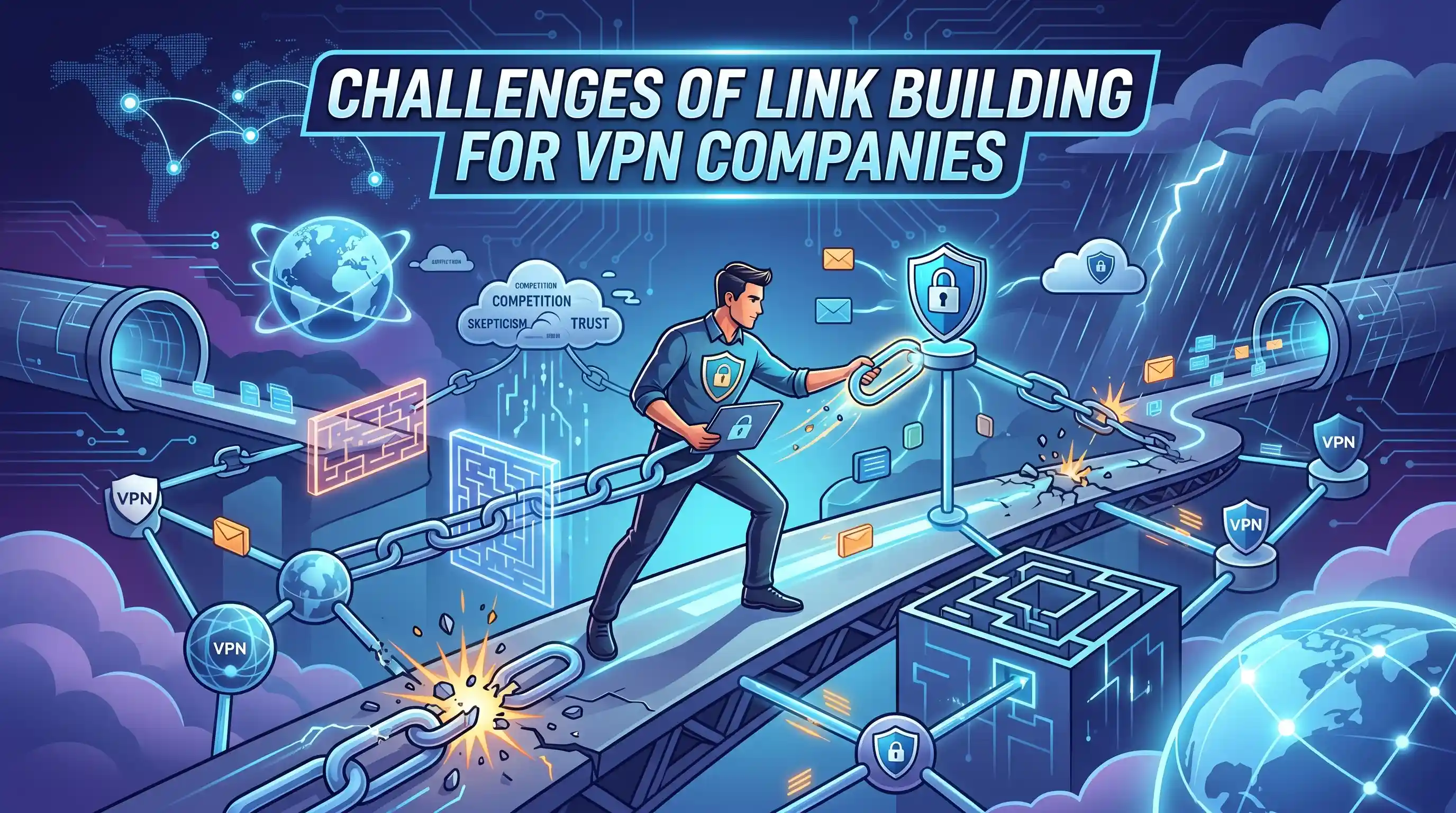
If you have ever tried to build backlinks for a VPN brand, you already know the feeling: outreach campaigns that go nowhere, referring domains that vanish overnight, and editors who will not touch your client with a ten-foot pole. VPN link building is a category of its own, combining the difficulty of fintech, gambling, and legal services into one vertical. The brands that figure it out at scale gain a compounding organic advantage that competitors rarely close.
This article walks through the core challenges SEOs face when building links for VPN companies, and why a thoughtful, editorial-focused strategy is the only path that holds long-term.
Why VPN Is One of the Most Restricted Niches in Link Building
The short answer: association risk. Publishers, editorial teams, and link brokers all apply informal blocklists to industries they consider legally grey, politically sensitive, or simply reputation-damaging. VPN sits squarely in that category for several reasons.
Many countries actively restrict or outright ban VPN usage. Russia, China, Iran, Belarus, and others have implemented regulatory frameworks that criminalize unauthorized VPN services. Any publisher with global reach is aware that hosting a link to a VPN provider could put them at reputational or even legal risk in those markets. Even in Western markets, some editors associate VPNs with piracy, anonymity tools for bad actors, or simply products that do not belong on a legitimate editorial site.
This means your outreach pool shrinks dramatically before you even get started. A realistic acceptance rate on cold outreach in this vertical is significantly lower than in, say, travel or SaaS. Expect to work harder for every single placement.
The Publisher Vetting Problem
Even when a publisher agrees in principle to cover a VPN topic, the editorial scrutiny is higher. Writers want to know: is this brand legitimate? Is it based in a jurisdiction with a clear no-logs audit? Does it have certifications from independent security auditors?
This matters for link builders because it shifts the pitch. You cannot treat VPN outreach the same way you treat a generic software product. Publishers expect:
- Evidence of independent audits (e.g., Cure53, Deloitte, or similar third-party security firms)
- Clear jurisdiction information and a transparent privacy policy
- Media coverage from credible tech publications that can serve as social proof
If your VPN client has not invested in these trust signals, no amount of outreach creativity will compensate. Link building success in this niche starts with brand positioning, not with email sequences.
Content Quality Is Not Optional, It Is Your Entry Ticket
You are already walking into every publisher conversation carrying baggage. VPN is a sensitive category, and editors know it. The moment you add weak or generic content to that equation, you have answered their unspoken question for them: not worth the risk.
This means the content you prepare for outreach needs to be genuinely good. Not “good for a VPN brand.” Actually good. Data-backed, original, well-structured, and directly relevant to the publication's audience. A thin 400-word overview of what a VPN does will not move the needle anywhere worth being. What does work is original research on privacy threats, expert commentary tied to a current news hook, or detailed technical guides that a security-conscious readership would actually save and share.
The bar here is higher than in most niches precisely because trust is lower. Publishers are already skeptical. Your content is your credibility before a single word of your pitch gets read. Treat it accordingly.
Domain Volatility and the Real Cost of Link Loss
One of the most underappreciated challenges in VPN link building is domain volatility. The SEO ecosystem around privacy tools attracts a disproportionate share of thin affiliate sites, private blog networks, and manipulative link schemes. Many sites that appear to rank well for VPN-adjacent keywords are operating on borrowed time.
When Google reassesses these networks, and it does so regularly, entire clusters of referring domains can evaporate simultaneously. A link profile that looks solid on a Monday can look damaged by the following month, through no fault of the brand itself.
But volatility is only half the problem. Even on legitimate sites, VPN backlinks face a specific removal risk that other niches do not. Publishers who previously accepted a placement may pull it later due to a Google penalty scare, a change in editorial policy, or a genuine legal concern about local VPN regulations. When you acquire links directly, without an established agency relationship in place, you have very little leverage to prevent this from happening.
The practical reality is that you should budget for link attrition from the start. A conservative assumption is that 10 to 20 percent of the links you acquire will be removed within 12 to 18 months if you are working without established publisher relationships. That number is not a reason to panic. It is a reason to build it into your projection model and your budget from day one, not discover it painfully after the fact.
This makes site-by-site vetting non-negotiable. Checking DR or DA alone is not enough. You need to look at traffic trend lines, ad density, editorial standards, and whether the site covers VPNs as a genuine editorial topic or purely as a monetization vehicle.
The Premium Publishers Charge in This Niche
If you have run link building campaigns in other industries, the pricing in VPN will come as a rude surprise. Publishers who accept placements in this space routinely charge 50 percent more than their standard rate, and a premium of 100 percent above the norm is not unusual. The reasoning is consistent: more editorial risk, more potential legal exposure, and a product category that requires more justification to their readership.
This premium is not negotiable in most cases. You can sometimes reduce it with strong content, a credible brand profile, or an agency relationship the publisher already trusts, but the baseline cost of acquiring links in VPN is structurally higher than in most other niches. Any budget planning that does not account for this will result in either underspending on quality or burning through the budget faster than anticipated.
How Intseo Media Approaches This Problem
Intseo Media has developed a specific methodology for acquiring backlinks in difficult verticals, and VPN is one where their approach is particularly relevant. Rather than relying on outreach volume alone, Intseo Media focuses on building genuine editorial value: contributing expert commentary, original data, and research-backed content to publications that have an actual audience interested in privacy and cybersecurity.
What gives Intseo Media a structural advantage in this niche is the scale of their established publisher network. With over 150,000 website owners in their database, including many who specifically work with privacy and technology verticals, they are not cold-pitching every placement. Many publishers already know the agency, trust it, and are significantly more willing to work with a known contact than with a direct brand approach they have never encountered before.
This matters for link retention as much as it matters for acquisition. When a publisher has an ongoing relationship with an agency, they are far less likely to remove a link impulsively over a legal concern or a penalty scare. The relationship creates a natural channel for resolving issues before removal becomes the default response. That translates directly into a more stable, defensible link profile over time.
Their process also includes systematic auditing of each placement site prior to outreach, removing the risk of investing budget into links that are likely to be devalued or removed within 12 months.
Geographic Targeting Adds Another Layer of Complexity
VPN companies rarely compete in a single market. Their keyword targets span dozens of languages and countries, which means link building campaigns need to think multilingually and multi-jurisdictionally from the start.
Building links for a VPN brand in Germany, for example, requires targeting German-language publishers who cover digital privacy, data protection under GDPR, and consumer tech. The same brand competing in Brazil needs Portuguese-language placements on sites that reach a mobile-first, cost-sensitive audience. These are fundamentally different editorial ecosystems, and the same pitch does not work across both.
The additional complication: in some countries, publishers are genuinely uncertain whether covering a VPN product creates any compliance exposure under local telecommunications or data laws. This slows editorial decisions and increases the number of touchpoints required to close a placement.
Anchor Text Strategy Under Heightened Scrutiny
VPN is one of the highest-competition niches in organic search. Head terms like “best VPN” and “VPN for streaming” carry enormous traffic value, and brands have historically been aggressive about targeting them through link building.
Google has responded accordingly. The algorithm is particularly sensitive to unnatural anchor text patterns in this vertical, and manual actions in VPN-adjacent SEO are not uncommon. An anchor text strategy that would be considered reasonable in a lower-competition niche can trigger scrutiny in VPN.
The practical implication: be more conservative with exact-match and partial-match commercial anchors than your instinct might suggest. A higher proportion of branded, naked URL, and topically relevant anchors is not a sign of weak strategy. It is mature risk management.
Building a Link Profile That Actually Holds
The brands that win organically in VPN over a multi-year horizon share a few common traits:
- They treat backlinks as a consequence of genuine content and PR investment, not as a standalone deliverable
- They diversify anchor text aggressively and prioritize editorial relevance over volume
- They build internal topic authority around privacy, security research, and threat intelligence, which naturally attracts inbound links from credible sources
None of this is quick or easy. But it compounds in a way that manipulative approaches do not.
Conclusion: VPN Link Building Is Hard. Work With People Who Know the Territory.
VPN link building is genuinely one of the most challenging SEO disciplines you can work in. The publisher pool is restricted, content standards are higher, pricing premiums are real, link attrition is a built-in cost, and the geographic complexity multiplies all of it. There are no shortcuts that hold.
What does work is combining rigorous brand positioning, high-quality content, smart budget planning, and, critically, working with people who already have the publisher relationships to make it happen. An experienced agency like Intseo Media, with over 150,000 established website owner relationships and a proven track record specifically in VPN link building, gives you a meaningful head start in a niche where cold outreach alone rarely gets the job done.
Fabi Gylgonyl and his team are ready to help you close the gap. If you are serious about building a link profile that can withstand algorithm updates, publisher pressure, and the unique legal sensitivities of this space, get in touch.

About the author
Fabi Gylgonyl
Link building specialist · Intseo Media
Fabi Gylgonyl is a link building specialist who has been helping VPN companies earn authoritative backlinks across all markets, including some of the most difficult and restrictive countries in the world. His hands-on experience across multiple jurisdictions makes him uniquely positioned to break down what makes this niche so notoriously tough to crack.